Choosing the right preschool is more than just selecting a place to care for your child; it’s about finding an environment that fosters creativity, curiosity, and emotional growth. At the heart of many high-quality early learning centers is the Waldorf-inspired preschool philosophy, which emphasizes holistic development, hands-on experiences, and nurturing the whole child. In this blog, we’ll explore how this philosophy shapes early learning and why it matters for toddlers in Santa Clara County.
Child-Centered Learning Programs
One of the cornerstones of the Waldorf approach is child-centered learning programs. In philosophy, the child becomes the focal point of all activities, ensuring that educational exercises are personalized according to his/her personal development needs. As opposed to having a predetermined curriculum to follow, teachers pay close attention to what interests, skills, and emotions each child is experiencing.
A child-centered approach to education involves encouraging children to be curious and creative in exploring the world around them and discovering things through practical experience. Toddlers are left to indulge freely in activities that appeal to them, ranging from block construction, painting and drawing, or listening to stories.
Play-Based Learning Philosophy for Early Learners
Play is not just fun, it’s fundamental to early development. The play-based learning preschool philosophy Understands that young learners acquire knowledge through active participation and play. Playing allows for toddlers to build cognitive, social, and emotional skills.
This can be done through activities such as pretending to be shopkeepers, chefs, and explorers among others. These activities help them to communicate, work with others, and empathize with other people. This is also a good way for kids to engage in experimenting, decision-making, and experiencing consequences.
Preschool Values and Teaching Approach
A preschool’s core values shape its teaching approach. Preschool values and teaching approach Respect, empathy, and the promotion of independence are all stressed in our approach. The teacher serves as an example, demonstrating patience, and helping children navigate social situations as they develop problem-solving skills.
Predictability and consistency in this environment are key elements that ensure security for young learners as they engage with new ideas. Creative activities are structured to be both fun and instructional, with lessons in language, math, and science incorporated. A combination of good values and effective educational strategies results in well-rounded development.
.
Nature Exploration and Creative Expression for Preschoolers
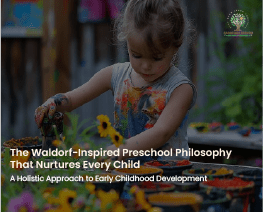
The combination of outdoor activity and creativity plays a major role in Waldorf-based philosophy. Outdoor explorations for preschool children provide them with an opportunity for active learning and developing their awareness of nature. Exploring plants in a garden, looking at various insects, and gathering natural material contributes to the development of curiosity and observation skills.
Besides, preschool creative expression activities give preschoolers the opportunity to express their feelings and thoughts through art, music, and movement. Creative activities like painting using natural materials or singing songs within a group improve fine motor skills and contribute to self-confidence.
Social-Emotional Growth in Early Childhood
Early education is not just about academic readiness it’s also about emotional intelligence. Social-emotional learning in preschool helps toddlers learn to recognize and deal with their emotions, make connections with others, and solve any problems that may arise from conflict. Group activities and projects will enable children to become empathetic and cooperative members of society.
This will make them ready to face future challenges socially and academically. Social-emotional skills are among the factors that can predict success in life. Therefore, social-emotional competence is a crucial element of preschool philosophy.
Bilingual Language Development Programs
Waldorf-influenced pre-schools usually have bilingual language classes wherein students are taught a second language along with their first one. The ability to learn another language is beneficial as it helps develop cognitive flexibility, problem-solving abilities, and improved memory.
Bilingual education may include songs, stories, and practical tasks in learning a second language, thus making learning fun. Along with improving language skills, a bilingual program also increases knowledge about culture and helps broaden the horizon of children.
Why Philosophy Matters for Preschool Success in Santa Clara County
Selecting a preschool with a strong educational philosophy can make a profound difference in your child’s growth. A center that prioritizes holistic development, creativity, and emotional intelligence provides a foundation for lifelong learning.
In Santa Clara County, With regard to families that are looking for quality early childhood education, the Waldorf-style and child-oriented approach guarantees that the children will be engaged, confident, and well-prepared for any future academic and social challenges. In essence, the philosophy seeks to develop the whole child mind, body, and spirit.
Conclusion
Preschool philosophy provides an overall approach to the learning process, interaction, and development of children. Combining the preschool philosophy inspired by Waldorf, child-centered learning approach, play-based learning method, exploration of nature, creative activities, and bilingualism can create an ideal setting for toddler education. For parents living in Santa Clara County, it is necessary to find a preschool that supports the overall development of a child to ensure they become confident, creative, and emotionally intelligent adults.
FAQs
Q1: What is Waldorf-inspired preschool philosophy?
A1: It is an approach to early childhood education that focuses on holistic learning, creativity, and nurturing the whole child.
Q2: How does child-centered learning benefit preschoolers?
A2: Child-centered programs tailor learning to each child’s interests and pace, boosting curiosity, independence, and engagement.
Q3: What is play-based learning in preschool?
A3: Play-based learning uses structured and unstructured play to develop social, emotional, cognitive, and motor skills in toddlers.
Q4: How do nature exploration and creative activities help children?
A4: Nature and creative activities enhance observation skills, imagination, fine motor development, and confidence through hands-on learning.
Q5: Does Waldorf-inspired preschool include language programs?
A5: Yes, many programs incorporate bilingual language development to encourage early communication skills and cultural awareness.